
I’m starting the first new outfit I’ve done in some time. Not only is it needed, as I’ve gained a bit of weight, but my wardrobe needs expansion as I become more active. I thought I would take the time to log the process and commentary.
First off, I’m a big fan of Modern Maker (MM) and have really focused on absorbing a lot of the technique and process he has written about. But I also use a book published by the V&A called 17th-Century Men’s Dress Patterns 1600-1630.
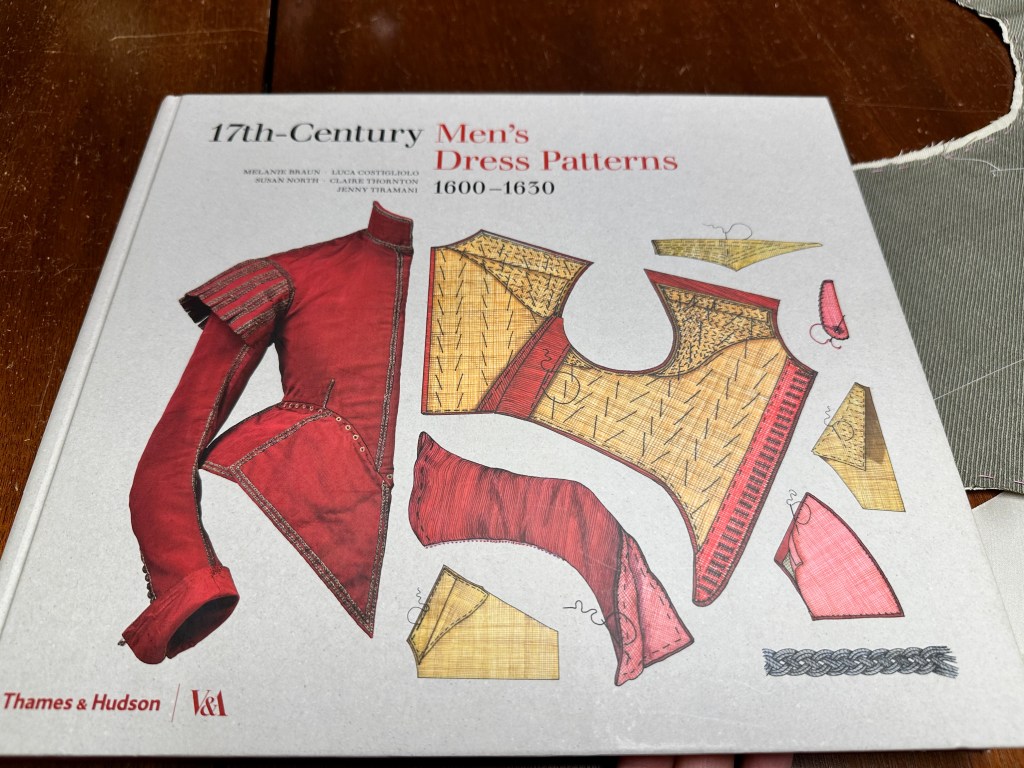
This book is slightly out of period but still describes a lot of the same techniques, if not the fashions of the 16th century. There are some interesting details throughout that I try to incorporate into my tailoring. It’s a great book for those who are already familiar with putting together a garment and want to see additional breakdowns of extant garments. It does not instruct, however, so some prior knowledge is needed.
The wool suit project will be a doublet and trunk hose made from some black and gold wool from Burnley & Trowbridge and lined with plain white linen. It is interlined with cream linen and a heavy undyed linen fabric is used for the padding around the shoulders and other stiffening areas. I’ll likely add trim in black wool, though may weave up some black trim instead.
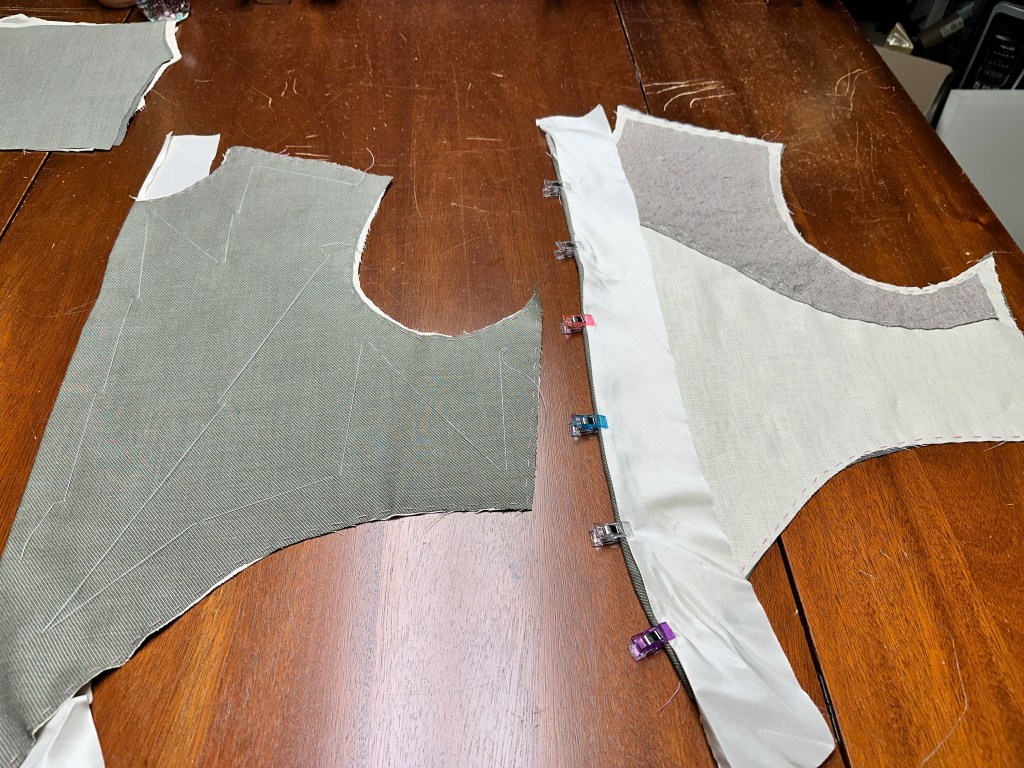
I have completed the body fronts so far, just short of the focused work of doing buttonholes by hand. I padstitched the rough linen shoulder pieces onto the interlining and then basted the fine wool layer on while gently stretching it with one hand. (left piece in the image) This is a MM technique that keeps a smooth fashion layer as you work with the combined piece. The layers were then basted together again around the edges. I leave the smoothing basting on for a while to keep everything together. The right side piece then got a quarter inch strip of thick linen down the front to support the buttons, which is a technique described in the V&A book. If you’re familiar with MM’s thread buttons you will recall they are attached to the edge of the fabric, so this additional technique from the V&A helps.

I used bias cut cream silk to face both sides which kind of bugs me. Silk adds less bulk and I like to use it for the facing, but that elevates the garment out of the middle class. I don’t think I mind with this garment, but if I were making a strictly middle class outfit it would be bias cut linen. Either way, always bias cut or else it can come apart around the button holes and start nastily fraying.
Another lesson learned that I’ll apply before I get into button holes is re-enforcing the front edge up to the collar. I’m doing a short English collar for this and not the high Spanish you see in MM’s work, but for both I have found that adding some strips there keeps the front of the collar from collapsing under use.
The doublet isn’t much now, but the process has reached buttonholes, which is sort of a tailoring gate for me to pass, so I will do those this week and tell you all about them… after I do some practice buttonholes!

 Cyboracle's Domain